
Roles and responsibilities
The Editor-in-Chief:
- has full authority over the entire editorial content of the journal;
- ensures that all submitted manuscripts undergo peer-review by at least two reviewers who are experts in the field;
- with recommendations from the executive editor and reviewer is responsible for deciding which of the manuscripts submitted to the journal will be published or not based on the merit and relevance of the article;
- in cases of proven scientific misconduct, as supervisor of the publication process, in close collaboration with the editors, will take all reasonable steps to solve the problem.
Executive editor:
- evaluates submitted manuscripts exclusively on the basis of their academic merit and its relevance to the journal’s scope, without discrimination;
- will not disclose any information about a submitted manuscript to anyone other than the author of the manuscript or reviewers and will not use unpublished information for their own purposes and personal advantage;
- will take appropriate measures when ethical issues emerge regarding the submitted paper;
Reviewer:
- assists Executive Editor in making editorial decisions and may assist authors in improving their manuscripts;
- in case the reviewer feels unqualified or unable to review the submitted manuscript, he/she immediately notifies the Editor-in-Chief;
- conducts objective review and formulates comments firmly with supporting arguments so that enables authors to improve their manuscript;
- must treat any manuscripts received as confidential and they must not be discussed;
- must not use the information in the submitted manuscript for her/his own research, purpose, or personal advantage without the consent of the authors.
Editorial Assistant:
- assists in managing the submission and peer-review process, including correspondence with authors and reviewers;
- assists in editing manuscripts for clarity, consistency, and style;
- supports the editor(s) in preparing articles for publication, including formatting and reference management;
- coordinates with authors, reviewers, and editorial board members to ensure smooth communication;
- maintains records, databases, and publication schedules;
- assists with content for website updates, social network pages, or promotional materials;
- handles administrative tasks such as tracking deadlines, preparing reports, etc.
Proofreading editor:
- reviews manuscripts for grammar, spelling, punctuation, and typographical errors;
- ensures consistency in style, tone, and formatting according to the journal’s editorial guidelines;
- checks accuracy of references, citations, headings, and captions;
- verifies clarity, readability, and logical flow of the text without altering the author’s meaning;
- identifies and corrects inconsistencies in terminology, abbreviations, and numbering;
- collaborates with editors to resolve language or formatting issues;
- conducts final checks on proofs before publication to ensure error-free content.
Authors:
- should present an accurate and original manuscript with sufficient detail enabling others to reproduce the published article;
- should ensure that they have written and submitted entirely original works;
- should understand that fraudulent papers and plagiarism from the authors’ side constitute unethical publishing behaviour;
- should not submit a manuscript for publication that has already been published elsewhere before;
- should disclose any conflicts of interest that might influence the results of their manuscript;
- are obliged to participate systematically in the peer review process and cooperate fully by responding and in a timely manner to editors’ requests for additional clarifications and re-submitting their manuscript to the journal in a required time slot;
- are obliged to notify the journal’s editors to correct the paper when he/she finds out significant inaccuracies in their own published work.
All parties involved—authors, editors, reviewers, and the publisher—are expected to adhere to the following responsibilities.
Responsibilities of Authors
- Authors must ensure that their work is original, accurate, and has not been published elsewhere (except in the form of an abstract or preprint, where applicable);
- Plagiarism, data fabrication or falsification is strictly prohibited;
- All sources used in the work must be properly cited and acknowledged;
- Authors must disclose any financial or personal conflicts of interest that could influence their work;
- Authorship should be limited to those who have made a significant contribution to the research and writing of the manuscript;
- Authors must promptly inform the editor if they discover a significant error or inaccuracy in their published work.
Responsibilities of Editors
- Editors are accountable for all content published in the journal and must make fair, unbiased decisions based solely on scholarly merit;
- Editors must ensure a transparent and rigorous peer review process while safeguarding the confidentiality of authors during the review process;
- Editors should avoid any conflict of interest and recuse themselves from handling manuscripts where such conflicts exist;
- Cases of suspected misconduct (e.g., plagiarism, duplicate submission, or falsified data) will be investigated with retraction or correction applied when necessary.
Responsibilities of Reviewers
- Reviewers must provide objective, constructive, and timely feedback to assist editors in making editorial decisions and to help authors improve their work;
- Reviewers must maintain strict confidentiality regarding the manuscript and may not use unpublished material for personal advantage;
- Reviewers should declare any conflicts of interest and decline to review if they are unable to provide an unbiased assessment;
- Reviewers should alert editors to any suspected ethical concerns, including plagiarism, data manipulation, or duplicate submission.
Responsibilities of the Publisher
- The publisher is committed to supporting the editorial team in maintaining academic integrity;
- The publisher ensures that cases of alleged misconduct are properly investigated and that appropriate corrective actions (such as retractions, corrections, or expressions of concern) are implemented;
- The publisher is responsible for ensuring permanent access to all published content and for preserving the integrity of the scholarly record.
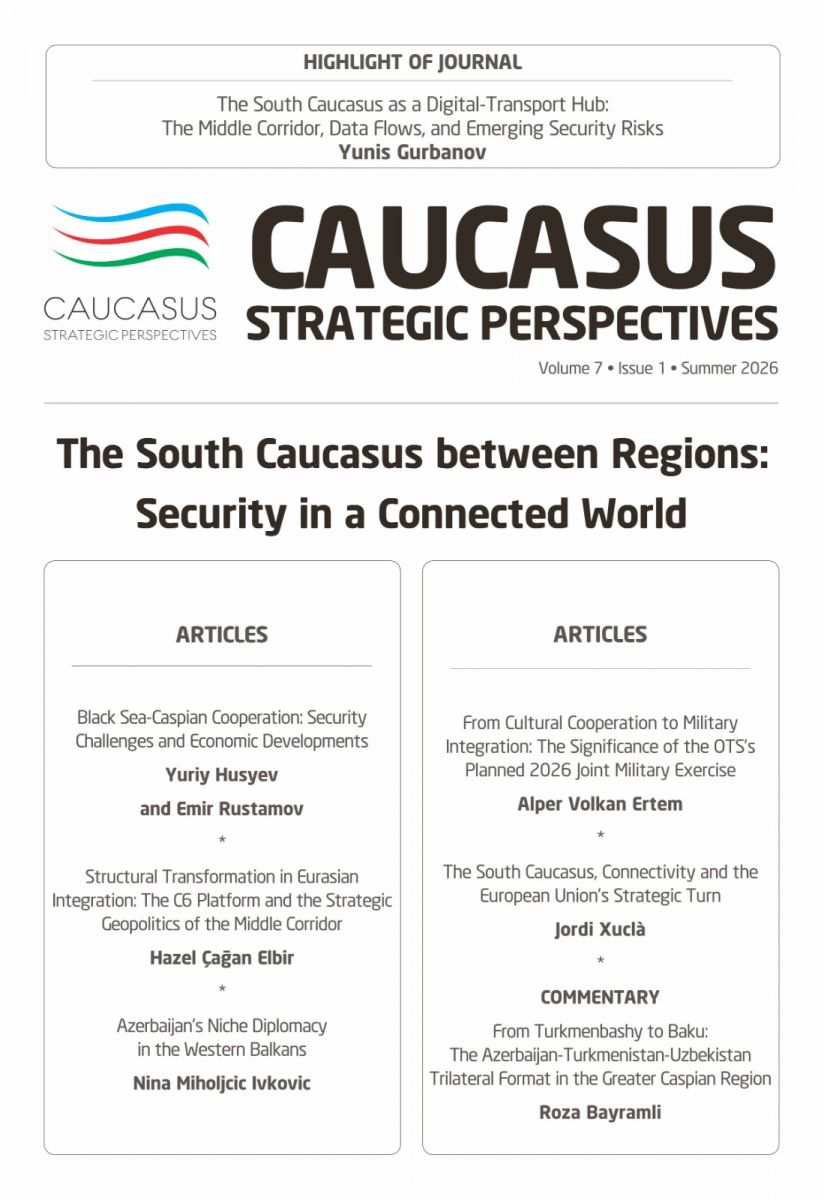


Latest news
Popular articles
- 07/18/2022 The Russia–Ukraine War: Perspective of Azerbaijan 8219 views
- 10/14/2020 The Non-Aligned Movement: In Pursuit of Validity and Relevance in the Contemporary Global Order 5610 views
- 10/14/2020 Vicious Circle of the South Caucasus: Intra-Regional Conflicts and Geopolitical Heterogeneity 4822 views
- 10/14/2020 Relevance of Non-Alignment for Azerbaijan’s Foreign and Security Policy 4638 views