
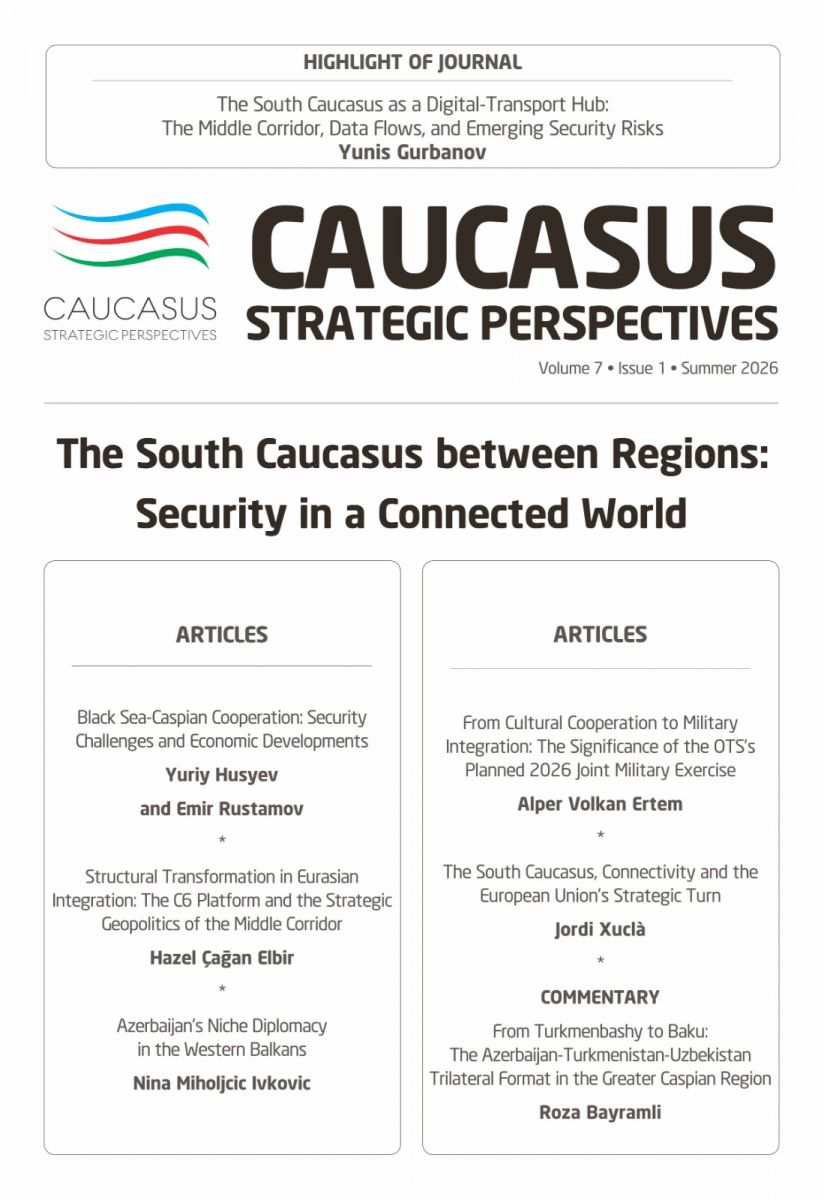
The South Caucasus, Connectivity and the European Union’s Strategic Turn
This article examines the South Caucasus as an emerging geoeconomic hub and analyses the European Union’s strategic turn towards the region since 2022. This turn was driven by the interaction of three factors. First, Russia’s war against Ukraine forced the European Union (EU) to accelerate energy diversification and to give greater value to east–west routes outside Russian control. Second, the Armenia–Azerbaijan normalization process and the weakening of Russia’s regional role made the South Caucasus more available for energy, transport and diplomacy. Finally, Azerbaijan exploited this opening through its energy infrastructure, transit position, relationship with Türkiye and multi-vector foreign policy. This causal sequence creates the article’s main puzzle: although the EU has become more dependent on a stable and connected South Caucasus, its institutions have not moved in the same direction. The European Commission, the Council of the EU and several member states of the Union have treated Azerbaijan as a necessary partner for energy security, access to the Caspian and Central Asia, and the development of the Middle Corridor. However, the European Parliament has followed a more hostile line, often returning to conflict-era language and weakening the EU’s credibility in the post-conflict regional order. The South Caucasus simultaneously constitutes a corridor of energy diversification, east–west connectivity and geopolitical competition. The EU’s influence in the region will depend on its capacity to align strategic language, institutional discipline and investment decisions.


Latest news
Popular articles
- 07/18/2022 The Russia–Ukraine War: Perspective of Azerbaijan 8221 views
- 10/14/2020 The Non-Aligned Movement: In Pursuit of Validity and Relevance in the Contemporary Global Order 5611 views
- 10/14/2020 Vicious Circle of the South Caucasus: Intra-Regional Conflicts and Geopolitical Heterogeneity 4822 views
- 10/14/2020 Relevance of Non-Alignment for Azerbaijan’s Foreign and Security Policy 4639 views