
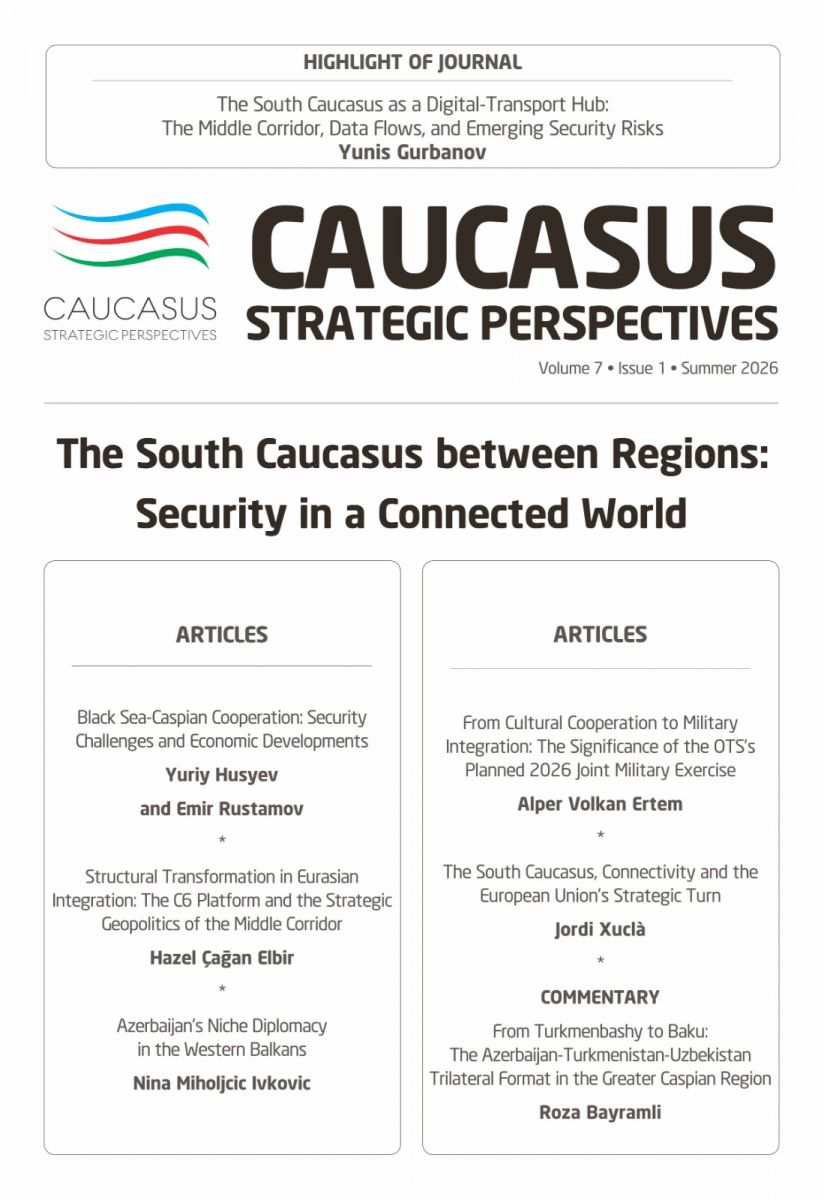
The South Caucasus as a Digital-Transport Hub: The Middle Corridor, Data Flows, and Emerging Security Risks
This article discusses the nature of the Middle Corridor, which is changing from a mere transport corridor via a new strategy that integrates connectivity, digitization, cybersecurity and geoeconomics. Specifically, the article discusses how the South Caucasus, and particularly Azerbaijan, is emerging as not only a transit hub connecting Europe and Asia but also potentially as a digital security node that connects Central Asia, the Caspian Sea basin, Türkiye and European markets. The primary focus of this article will be on the evolving connection between two concepts – transport corridors and data corridors – which it will examine through a discussion of digital infrastructure in the Caspian Sea region, digitalized customs and logistics systems, e-commerce sites and cybersecurity cooperation. The key message here is that the future importance of the Middle Corridor will not depend solely on sea ports, railway tracks and roads; it will increasingly rely on securing digital connectivity and establishing cybersecurity strategies along those transit routes. The article considers the changing dynamics of Eurasia by taking note of alternative routes to existing northern ones; the growing relevance of the Organization of Turkic States (OTS); the European Union’s (EU) interest in connectivity and digital connections; Chinese Belt and Road logic; and concerns about hybrid threats in the region. In conclusion, the implementation of a safe digital component of the Middle Corridor could help reinforce the South Caucasus’ role as a regional centre of geoeconomic initiatives; however, this can only be achieved by overcoming the current fragmentation of infrastructure projects and shifting to an integrated model of digital governance, cybersecurity and international data collaboration.


Latest news
Popular articles
- 07/18/2022 The Russia–Ukraine War: Perspective of Azerbaijan 8221 views
- 10/14/2020 The Non-Aligned Movement: In Pursuit of Validity and Relevance in the Contemporary Global Order 5611 views
- 10/14/2020 Vicious Circle of the South Caucasus: Intra-Regional Conflicts and Geopolitical Heterogeneity 4822 views
- 10/14/2020 Relevance of Non-Alignment for Azerbaijan’s Foreign and Security Policy 4639 views