
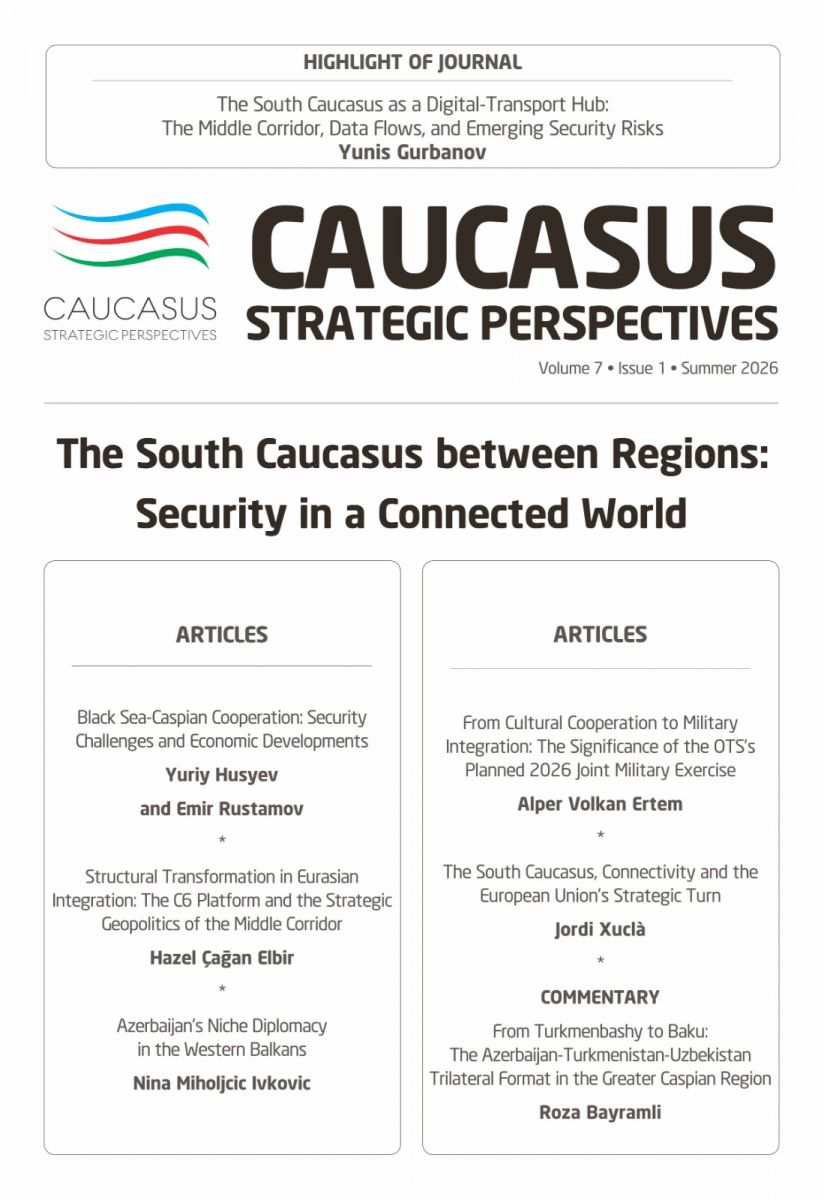
Black Sea–Caspian Region Cooperation: Security Challenges and Economic Developments
The Black Sea–Caspian region has reemerged as a central arena of geopolitical contestation and connectivity in the 21st century. Stretching from Eastern Europe through the South Caucasus to Central Asia, it represents a strategic hinge between the Euro-Atlantic area, the post-Soviet region and Asian centres of production. This article examines the evolving security architecture and economic prospects of the Black Sea–Caspian macro-region, with particular emphasis on the prospects for multilateral cooperation among Ukraine and its strategic partners in this region – Azerbaijan, Türkiye and Romania. Drawing on realist, liberal institutionalist and constructivist perspectives in international relations, the study argues that the region is undergoing structural transformation driven by Russia’s full-scale invasion of Ukraine, war in the Middle East, the reconfiguration of Eurasian trade routes and intensified energy diversification efforts. Institutional mechanisms such as the GUAM Organization for Democracy and Economic Development and the Organization of Turkic States (OTS) have contributed to regional stability, while Western engagement has reinforced connectivity strategies. The analysis demonstrates that, although security dilemmas persist, expanding economic interdependence, infrastructure integration and normative convergence offer a pathway towards a more cohesive macro-regional order. The article concludes that the Black Sea–Caspian region is gradually transitioning from a fragmented geopolitical frontier into a dynamic, though still contested, centre of Eurasian connectivity.


Latest news
Popular articles
- 07/18/2022 The Russia–Ukraine War: Perspective of Azerbaijan 8221 views
- 10/14/2020 The Non-Aligned Movement: In Pursuit of Validity and Relevance in the Contemporary Global Order 5611 views
- 10/14/2020 Vicious Circle of the South Caucasus: Intra-Regional Conflicts and Geopolitical Heterogeneity 4822 views
- 10/14/2020 Relevance of Non-Alignment for Azerbaijan’s Foreign and Security Policy 4639 views